When people ask what goes under artificial grass, they usually picture rolling turf over the old lawn. In Aurora, that shortcut is exactly what leads to lumpy, poorly draining, weed-ridden results a year later. A lasting install is a layered system built from the ground up, and on York Region's clay and freeze-thaw conditions the base under the grass matters more than the grass itself. Here is what each layer does and how the installation process runs on a typical Aurora property.
What goes under artificial grass?
Under artificial grass sits a compacted crushed stone base over graded, excavated soil, usually with a weed barrier between the layers and infill worked into the fibres on top. From the bottom up, a proper Aurora system is: the excavated and graded sub-grade, a compacted crushed stone base, a weed membrane, the turf itself, and then the infill. Each layer has a job, and skipping any one of them shows up within a season.
Step by step: the Aurora installation process
Removing the old lawn and excavating
The first step is stripping the existing sod, roots and loose soil, typically excavating down about 90 to 100 mm (roughly 4 inches) for a residential lawn, and deeper for a pet or high-traffic area. Removing organic material matters because sod left underneath will break down over time and create dips.
Grading and drainage
Next the exposed sub-grade is shaped to fall away from the house and toward a drainage point. Getting the slope right is critical in Aurora, where clay soils in newer areas off Bayview and St John's Sideroad do not absorb water quickly. On problem lots we add a perforated drain line or a deeper stone layer so water always has somewhere to go.
The crushed stone base
The base is built from angular crushed stone, commonly a crushed limestone Granular A topped with a finer stone dust screening. Angular stone locks together when compacted, which gives a firm, stable surface that will not shift under foot traffic or heave unevenly through winter. This layer is the backbone of the whole install.
Compaction
Each lift of stone is compacted with a plate compactor and, on larger jobs, lightly wetted to help it bind. Proper compaction is what stops footprints, ripples and settling later. A base that is not fully compacted is the single most common cause of a turf lawn going wavy after the first Aurora winter.
Weed barrier
A geotextile weed membrane is laid over the compacted base to block anything from growing up through the turf while still letting water drain down. It also helps separate the base from the sub-grade so the layers stay clean.
Laying, seaming and securing the turf
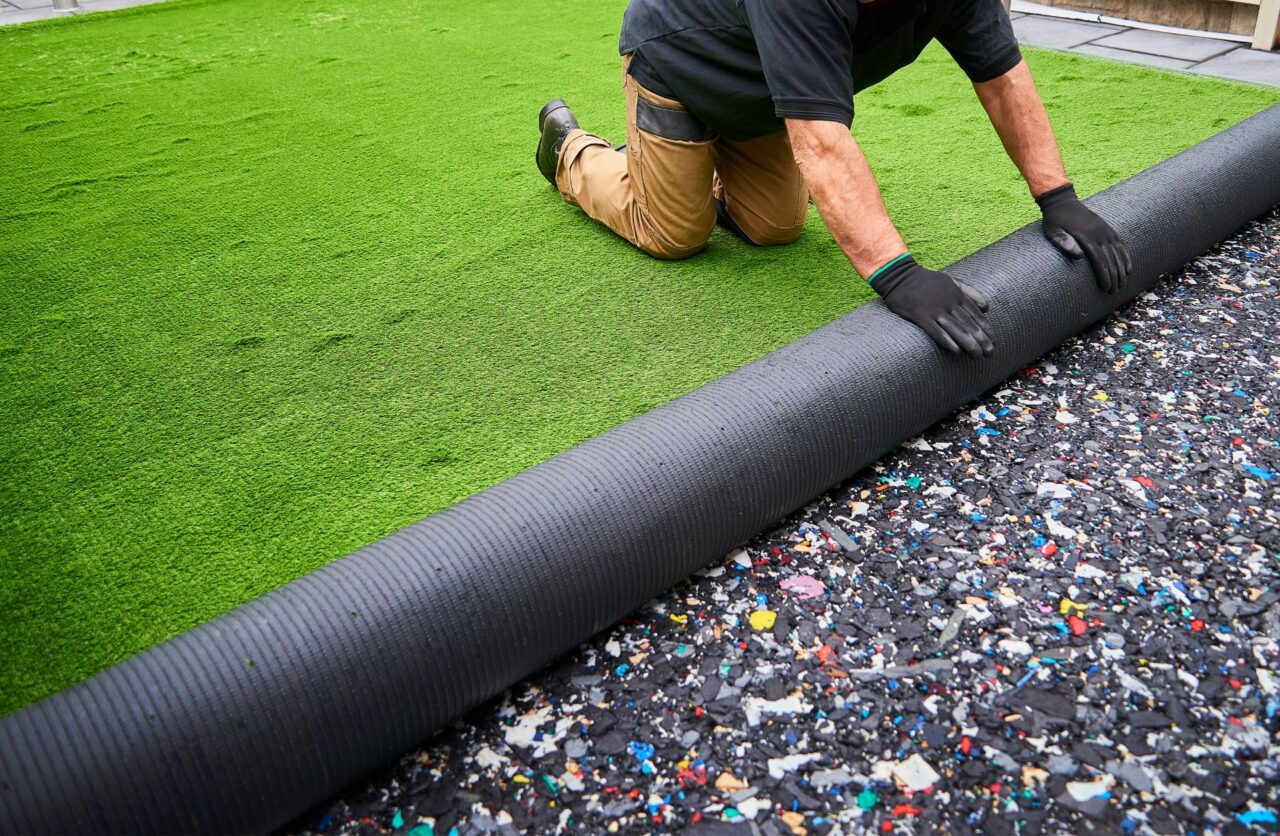
The turf is rolled out, left to relax so it lies flat, then cut to the yard's shape. Multiple pieces are joined with seaming tape and adhesive with the blades all running the same direction for a natural look. Edges are anchored with landscape nails or staples, and against patios or beds we fix the perimeter down so it cannot lift.
Infill and brushing
Finally a sand or specialty infill is spread across the surface and brushed into the fibres. Infill weighs the turf down, keeps the blades standing upright, protects the backing and aids drainage. The lawn is power-brushed to finish, which stands the fibres up and gives that fresh, just-mowed look.
Why base prep matters most in Aurora
Base preparation is where an Aurora install is won or lost. Sitting on and beside the Oak Ridges Moraine, the town has everything from sandy, free-draining kame soils to dense clay till within a short drive. Clay holds water, and when that water freezes and thaws through a York Region winter, a poorly built base heaves and the lawn goes uneven. A correctly excavated, graded and compacted crushed stone base gives water a path out and a stable platform that rides out freeze-thaw. That is why Artificial Grass Aurora spends most of the project time on what you never see once the turf is down.
How deep should the base be?
For a standard residential lawn, plan on roughly 90 to 100 mm of compacted stone, and more on heavy clay or for pet and high-traffic areas. A backyard putting surface is built differently again, with a tighter, precisely levelled base to give a true ball roll, which is why a putting green is priced as its own build. A quality family backyard lawn uses the standard depth unless a site assessment finds a drainage issue that calls for more.
On a lot with a known drainage problem, we may also tie a perforated drain line into a low point or a soakaway so heavy rain has a clear exit. That is a common addition on the flatter clay lots in the newer parts of town, where water has nowhere natural to go and a deeper, better-drained base is what keeps the finished lawn firm underfoot.
Frequently asked questions
Can you lay artificial grass directly over soil or an old lawn?
No, not for a lasting result. Grass laid straight over soil will drain poorly, grow weeds through the seams and settle into dips as the organic material below breaks down. A compacted stone base is essential.
What kind of stone goes under artificial grass in Aurora?
Angular crushed limestone, usually a Granular A base topped with a finer stone dust screening. Angular stone compacts into a firm, stable layer that resists shifting and frost heave.
How long does an artificial grass installation take?
Most residential Aurora yards are completed in one to three days depending on size, access and how much excavation and drainage work the site needs.